kitchen
Why Your Pot Lids Never Stay Put (And the Weekend Test Before You Buy a Rack)
Home Insight Hub is an Amazon Associate and earns from qualifying purchases. Read the full disclosure.
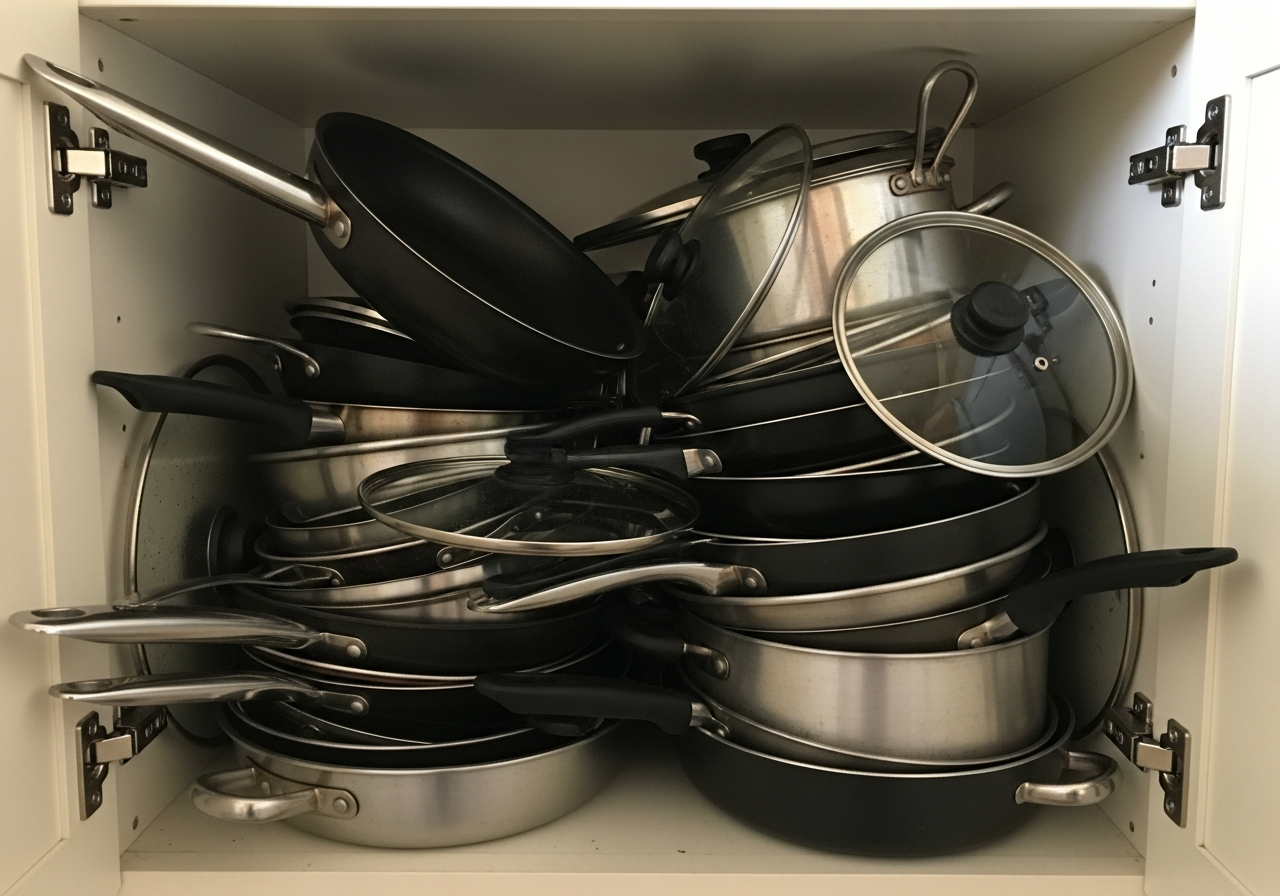
You open the cookware cabinet for one saucepan. Three lids skate forward, a glass lid rings off a skillet, and the one you need is the last disc in the back. The pots were not the problem. The lids were.
Pot lids fail at stacking for a boring mechanical reason: knobs, straps, and helper handles stick up. They do not nest the way bowls nest. Leave them in a loose pile and every grab becomes a landslide. A rack can help later. First you need to know which lid pile you even have.
- Sort the pile: pot lids, leftover-container lids, and foil-box lids are three different jobs
- Match first: a lid that still has its pan can live on that pan
- Try one free test: on-pot stack, cabinet-door hooks, or a tension rod — not all three in one night
- Watch the door: if a handle stops the cabinet from closing, the storage failed
- Buy a rack last: only after a free test still leaves a sliding pile
The Lid Is a Different Shape Than the Pot
Pots nest. Lids argue.
A skillet can sit inside a stockpot. A lid cannot sit inside another lid unless the knobs are identical and you accept a wobbly tower. Glass lids add weight. Long helper handles stick out past the rim. Steam-vent knobs catch the next lid and drag the whole stack forward when you tug one piece.
The consensus from people who cook every night is blunt: the avalanche starts when lids live as a separate, unmatched pile. Matching a lid to its pan removes half the motion. Treating every disc like interchangeable Tupperware is how the cabinet starts sounding like a cymbal bag.
The flaw: matching only works when you still own the pan. Orphan lids — the glass circle from a pot you donated — do not earn cabinet space. They earn the donate box.
Pull every lid onto the counter. Pair each one with its pot. Anything with no pot leaves the cabinet tonight. Then pick one storage test below for the leftovers. If tomorrow night you can grab a lid with one hand and shut the door, you do not need a catalog of organizers.
What Usually Makes It Worse
1. You are organizing the wrong lids
The cookware bay is where leftover-container lids go to hide. Those snap-on squares do not belong next to a stockpot lid. If the avalanche is stained plastic circles and latch lids, stop. That is a leftovers problem, not a saucepan problem. Start with glass food storage that stops stains and smells and keep those lids out of the pot cabinet.
Foil, wrap, and sandwich-bag boxes are a third pile. They belong in a drawer or a bamboo bag-box organizer, not wedged beside a Dutch oven.
2. You stacked lids in a pile “just for now”
“Just for now” is how a glass lid learns to launch. A flat stack looks tidy for a day. The first person who needs the bottom lid recreates the original mess.
3. You hung heavy glass on a decorative hook
Cabinet-door hooks work for some metal lids. They fail when the hook is a tiny adhesive peg and the lid is a nine-inch glass disc. The door gets heavier. It slams. The hook creeps. 3M’s own Command project notes tell you to follow the pack: alcohol-wipe a smooth door, stay off textured or freshly painted wood, and respect the weight rating printed on the strip. Skip the rating and you are decorating, not storing.
4. You bought a tall pan tower for a lid-only mess
A two-foot cookware rack is the wrong tool for a seven-inch lid pile. That is how people return organizers after one weekend. Measure the opening first. Then decide if you even need metal.
Three Weekend Tests, One Cabinet
Do not install three systems. Pick the test that matches the cabinet you have.
Test A — Put the lid back on the pot
Turn the lid upside down on its own pot, or nest the pot with the lid inverted so the knob drops into the basin. Home-cook threads keep landing here because it costs nothing and the pair stays together.
The flaw: you only get a short stack. Mismatched lids still have nowhere to go. A tower of three heavy pots will tip if you yank the bottom one. Use this when you own four everyday pans, not a restaurant wall of copper.
Test B — Two hooks on the inside of the door
On a smooth, finished cabinet door, two indoor adhesive hooks can cradle one lid by the rim — one hook under the edge, one keeping it from kicking out. Cooking-forum consensus and 3M’s pot-holder project are the same idea: the door becomes a vertical file.
The flaw: the door now carries weight. Too many glass lids and the door sags or slams. Textured oak, damp laminate, and freshly painted doors shed adhesive. If you rent, use removable indoor strips and stop at one or two lids, not the whole set. If the door no longer closes softly, take the lids off.
Test C — A cheap tension rod as a fence
A spring tension rod from any hardware store, stood vertically or set front-to-back, can turn one cabinet bay into slots. Cooks have used this for years as a stand-in for a lid rack: the rod stops discs from skating into a single pile.
The flaw: rods walk. If the cabinet sides are not parallel, or the lids are heavy glass, the rod creeps and you are back to an avalanche plus a rod on the floor. Brace it tight. Use it for a few lightweight lids. Do not treat a shower rod as a Dutch-oven dock.
When a Rack Is Finally the Job
A free test should tell you by Sunday night.
You still need a rack if:
- More than three everyday lids have no honest home after pairing.
- Handles keep the door from closing no matter how you flip the lid.
- You also need sheet pans and cutting boards standing on edge in the same short opening.
That is a low expandable lid rack, not a tall stockpot tower. The pots and pans organizer that splits tall racks from lid racks exists for that fork: height and weight in one cabinet, lids and flats in another. Do not buy the tower because the thumbnail looked organized.
Skip the rack if Test A already made dinner quieter. Extra steel in a cabinet you already hate is just another thing to wipe.
Your Next Step This Weekend
Empty the cookware cabinet onto the counter. Pair lids. Donate orphans. Run one test — on-pot, door hooks, or a tension rod — on the two lids you grab most. Cook one meal. If you can find the lid in one motion and the door still shuts, stop shopping.
The win is not a catalog photo. The win is a Tuesday soup pot whose lid does not take three other lids down with it.
Frequently Asked Questions
Why do pot lids keep sliding everywhere? Knobs and helper handles keep lids from nesting. A loose pile becomes a landslide the first time you grab the bottom disc.
Should I store lids on the pots? Yes, if you only own a few everyday pans. Invert the lid or nest the pair. It fails when the stack gets tall or the lid no longer matches a pot.
Do adhesive hooks on cabinet doors work for glass lids? Sometimes, on a smooth door, with indoor hooks rated for the lid’s weight and a 3M-style alcohol prep. Glass is heavier than it looks. If the door slams or the hook creeps, stop.
Is a tension rod enough instead of a lid organizer? It can fence a few lightweight lids. It walks on uneven cabinet walls and it is a bad dock for heavy glass or cast-iron covers.
What if the sliding pile is leftover container lids? That is a different cabinet job. Keep pot lids with cookware. Move leftover lids back to the food-storage stack instead of mixing the two avalanches.
Full disclosure: As an Amazon Associate, we earn from qualifying purchases. Our recommendations are based on research, review analysis, and real household use only where explicitly noted. Commission rates play no role in what gets recommended — if a simple hardware-store fix beats a branded option, we'll say so.