kitchen
Why Your Pots Are Always Scratched (And the Rack That Finally Fixes the Stacking Problem)
Home Insight Hub is an Amazon Associate and earns from qualifying purchases. Read the full disclosure.
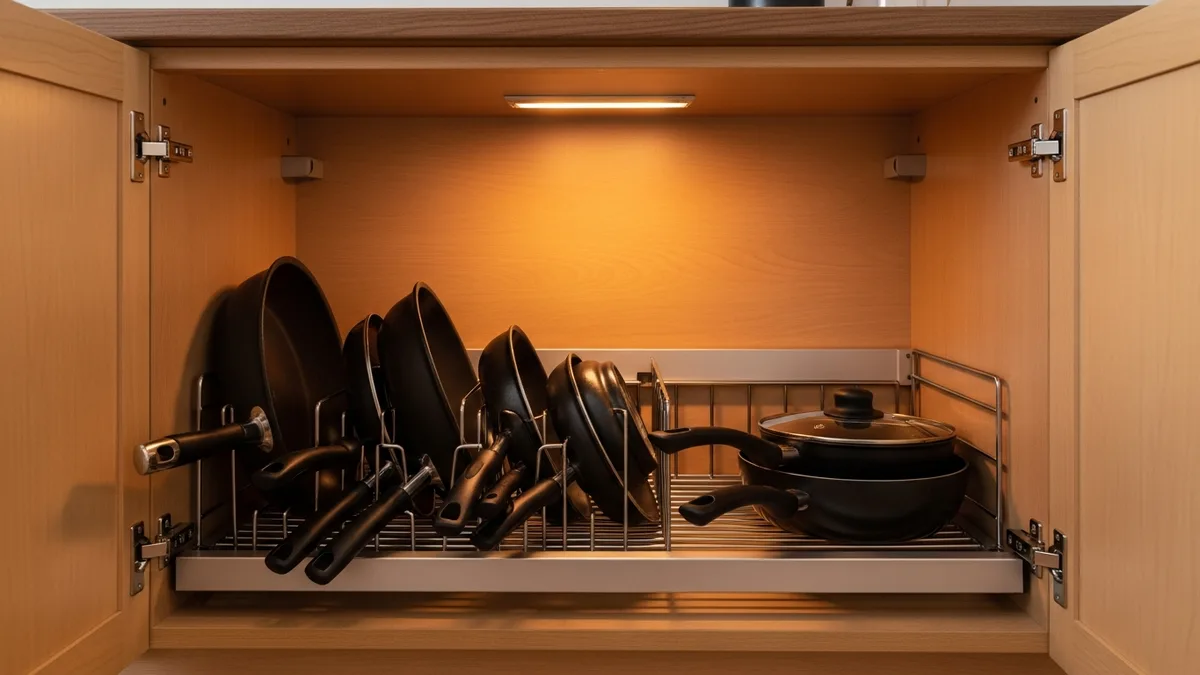
If heavy pots and skillets are stacked and scratching each other, start with the Ordora tall adjustable pan rack — vertical silicone-coated dividers, lid grooves, and a high weight rating for stockpots and Dutch ovens in base cabinets. Fair warning: the expansion joint can flex under a very heavy center load when the rack is widened a lot, and it only belongs in lower cabinets with real height. If your real mess is lids, sheet pans, and low-clearance shelves, skip the tall tower and use a low expandable rack like the ROOHUA 10-divider model instead.
Check if the Ordora Adjustable Pan Organizer is currently in stock on Amazon →
| Buy It For Life | Renter-Friendly | Hyper-Specific Fix | |
|---|---|---|---|
| Product | Ordora tall adjustable pan rack | ROOHUA expandable lid/pan rack | Lodge cast-iron counter rack or YouCopia bakeware rack |
| Better if | Tall stockpots, Dutch ovens, heavy skillets need vertical slots | Lids, shallow pans, bakeware, low shelves, no-drill setup | Daily cast iron on the counter, or only flat sheets/boards |
| Skip if | Cabinet height is short or you only store lids | You need deep heavy pots standing nearly two feet tall | You refuse any counter footprint / only need full cookware |
| Watch out | Expansion joint flex when very wide + heavy center load | Listing flags heavy/deep pots and long-handled lids | Counter space lost (Lodge) or height too short for pots (YouCopia) |
| Cost position | Usually mid-range kitchen organizer | Often under $30 | Check current price |
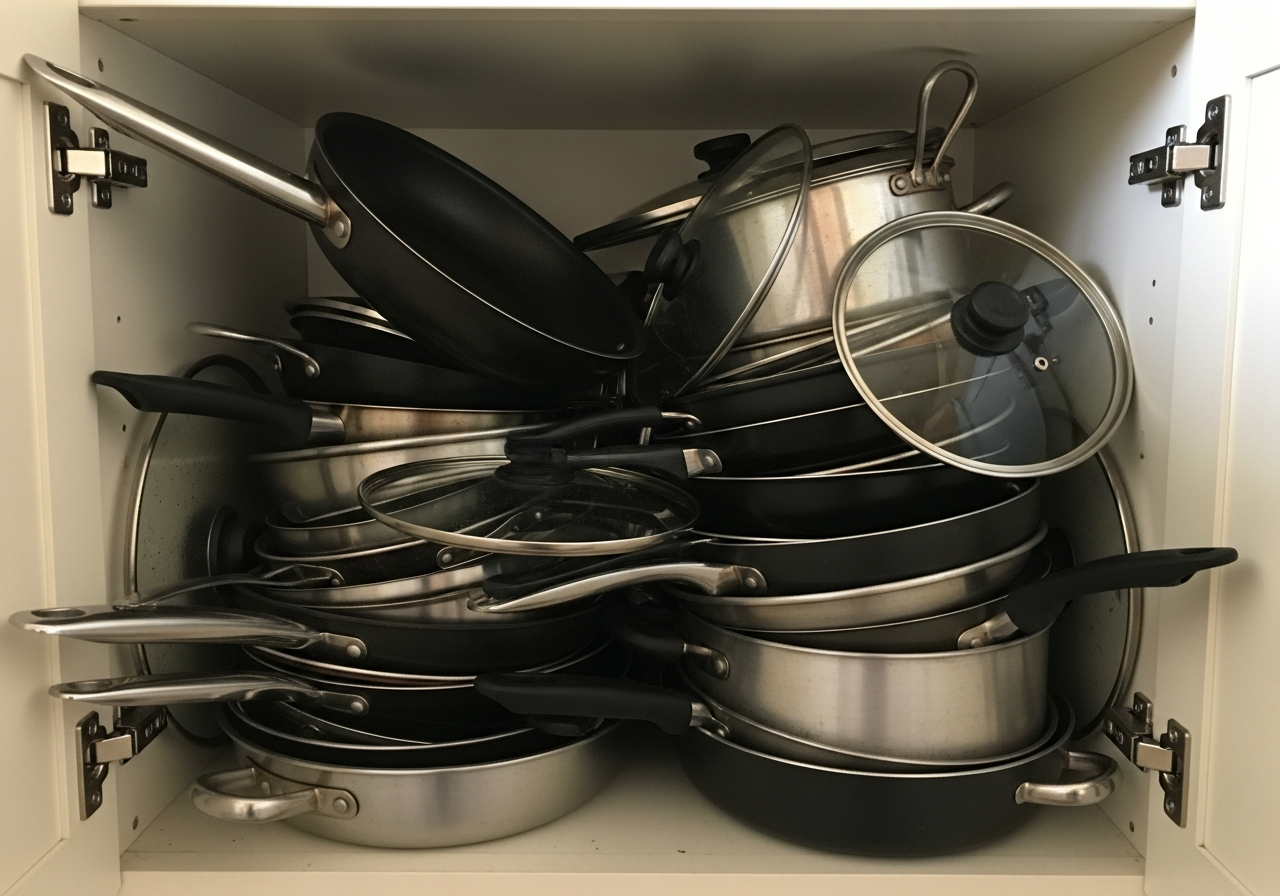
You know the sound of a heavy skillet sliding off a stack of pans and slamming into the cabinet wall at 6 AM. Then you pull the pan out and notice a fresh scratch across the non-stick coating — a thin silver line where bare aluminum now shows through. Meanwhile, the lid you need is buried somewhere behind three other lids and a colander you forgot you owned, and the only way to reach the 10-inch skillet on the bottom is to unstack every single pan on top of it, one by one, onto your counter.
The Real Problem Is How Pots Stack (Or Don’t)
Every time you pull a pan from a stack, the bottom of one drags across the cooking surface of the one below it. Metal on metal, over and over, every single day. Non-stick coatings aren’t built for that kind of abrasion. That ceramic pan you bought six months ago? The one with the scratch pattern that looks like a cat attacked it? That’s not defective. That’s just what happens when you stack cookware directly on top of itself inside a cabinet.
Lids make the whole situation worse. They don’t nest with their own pans — the handles stick up, the rims don’t align, and they end up in a separate pile that slowly migrates to the back of the cabinet. You end up with a stack of pans on one side and a graveyard of lids on the other, and matching the right lid to the right pot becomes a daily archaeology project.
The fix most people try first is felt pot protectors or those soft fabric pads you layer between pans. They help with scratching, sure. But the fundamental problem — digging through a vertical stack to reach the one you need — doesn’t change. You’re still unstacking. What actually solves this is storing cookware on edge, each piece in its own slot, with lids handled on purpose instead of as an afterthought.
There are two different racks for two different cabinets. Mixing them up is how people return organizers after one weekend.
Measure Height and Depth Before You Buy Anything
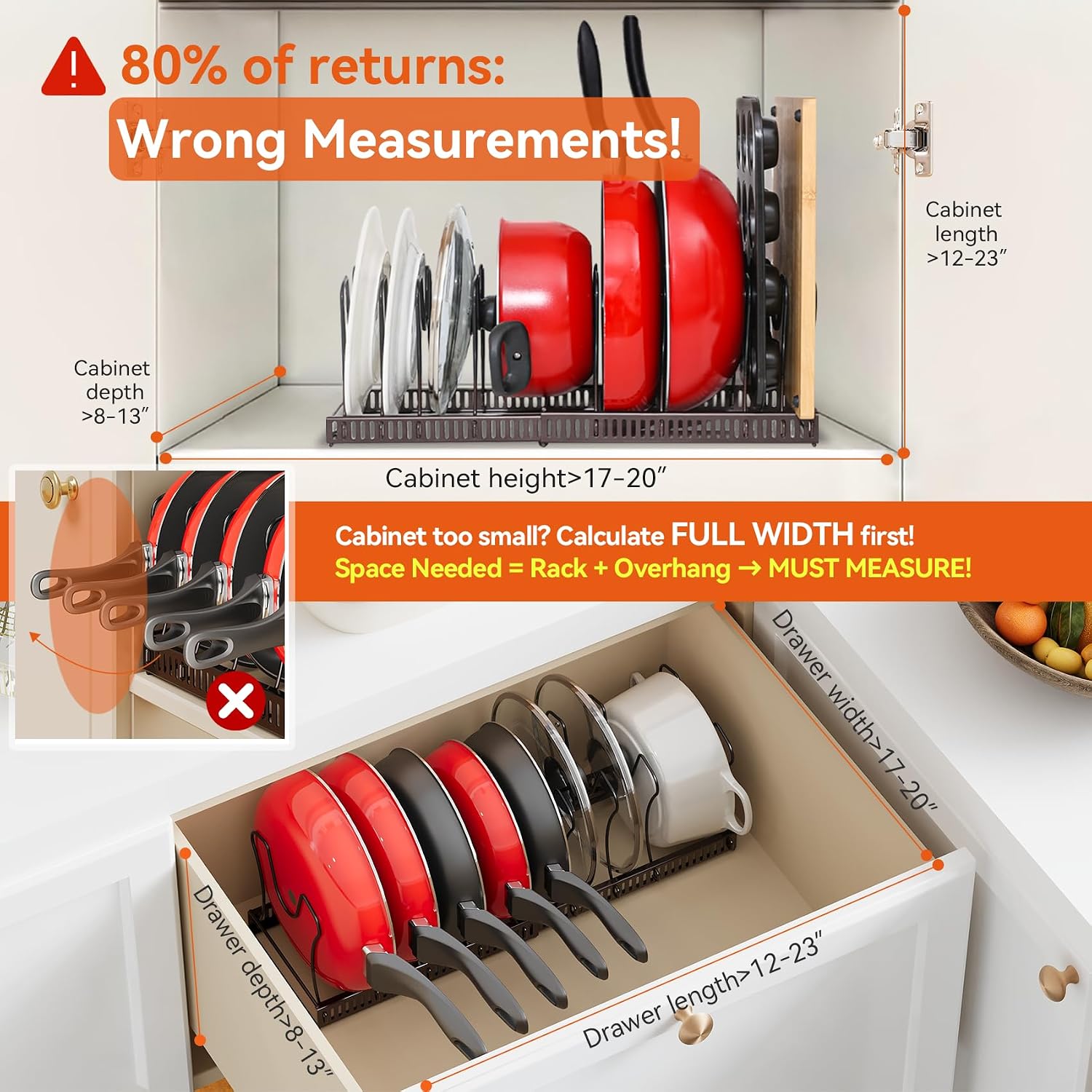
Here’s the thing every pan-rack review skips, and it’s the reason so many of these end up returned: cabinet height and depth, not just width.
Measure width first — most expandable racks stretch to fit. Then measure clearance height inside the cabinet. A tall heavy-duty rack needs roughly two feet of vertical room for stockpots standing on edge. A low lid rack is only about 7 inches tall and lives under shelves, in shallow base cabinets, or beside plumbing where a tower will never fit.
Then measure depth, front to back. A 12-inch skillet stored vertically has a handle that extends several inches past the rim. If your cabinet is shallow, that handle may stop the door from closing. Take 90 seconds and measure before reading the rest of this. Grab a tape measure. I’ll wait.
If the noise is lids skating forward every time you grab one pan, start with why pot lids never stay put before you buy a tall tower. Pair the lids. Try one free test. A rack is the next step only if that weekend still leaves a sliding pile.
The Fix for Heavy Cookware: Ordora Tall Adjustable Pan Rack
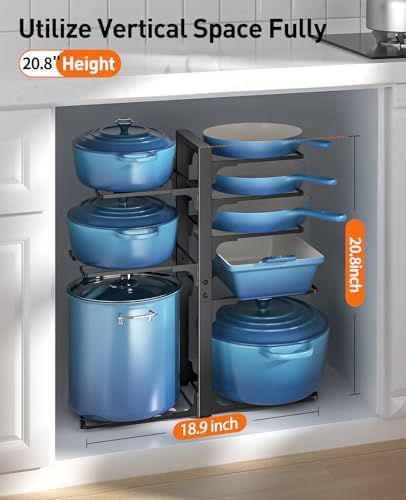
The flaw: When you expand this rack past about 18 inches, the overlapping base tracks lose rigidity right at the expansion joint. Drop a heavy Dutch oven dead-center on that seam and the base can bow slightly — enough that sliding pans in and out of adjacent slots gets sticky. It also only fits lower base cabinets with real height; don’t try to shove a ~20.8-inch-tall tower into a short upper cabinet.
Why It’s Still the Default for Tall Pots
Now that you know the downside, here’s why this is still the adjustable pots and pans organizer I’d point a friend toward when heavy cookware is the job. Listing claims put the Ordora around 20.8 inches tall with rubberized or silicone-coated dividers meant to cut metal-on-metal scratching, and a heavy-duty framing story aimed at stockpots, Dutch ovens, and cast iron up to about 12 inches across. The older research snapshot on this ASIN also carried a high total weight rating (on the order of 120 lbs across the rack / about 15 lbs per tier) — treat that as listing capacity, not a lab test from us, and still avoid parking the heaviest piece on a fully stretched center seam.
The lid story on the tall rack is the U-shaped groove idea: lids can stand in the same system instead of sliding into a separate avalanche. Matching each lid with its pan — not a mystery pile at the back of the cabinet — removes half the morning noise.
You can also split some Ordora configurations into two smaller racks. That helps when apartment plumbing runs through the middle of a cabinet or when you want cookware in two narrow openings instead of one overloaded bay.
Assembly is tool-light: dividers seat into the base track. Budget a few minutes and some hand pressure — review consensus often mentions the dividers take a firm push the first time.
Who this is for: Anyone with a lower base cabinet tall enough for a ~20.8-inch rack, especially if non-stick skillets and heavy pots currently live in a scratch stack.
Who should skip it: Short upper cabinets, cabinets that can’t clear skillet handles at the door, or kitchens where the only chaos is lids and sheet pans — that’s a different form factor below.
- Form: tall vertical pots-and-pans organizer for under-cabinet / base-cabinet use
- Listing height story: about 20.8" tall dividers for large stockpots and heavy cookware (up to ~12" class pieces on the listing)
- Research snapshot dimensions (earlier listing check): about 7.95"D × 18.9"W × 20.8"H in the dual-side configuration; some setups split into narrower single-side racks
- Dividers: adjustable tiers with rubberized / curved “pot-guard” style contact surfaces on the listing
- Capacity language on listing/research notes: heavy-duty frame; high total load claim with per-tier limits — still keep the heaviest pot off a max-width expansion seam
- Consensus signal (research snapshot): about 4.4★ with a very large Amazon review base on this tall Ordora family
- Install: no drill; dividers pop into the track (firm hand pressure is normal)
Ordora Adjustable Pan Organizer Rack
Tall vertical dividers for stockpots, skillets, and Dutch ovens when cabinet height can take a full cookware tower.
Check if the Ordora Adjustable Pan Organizer is currently in stock on Amazon →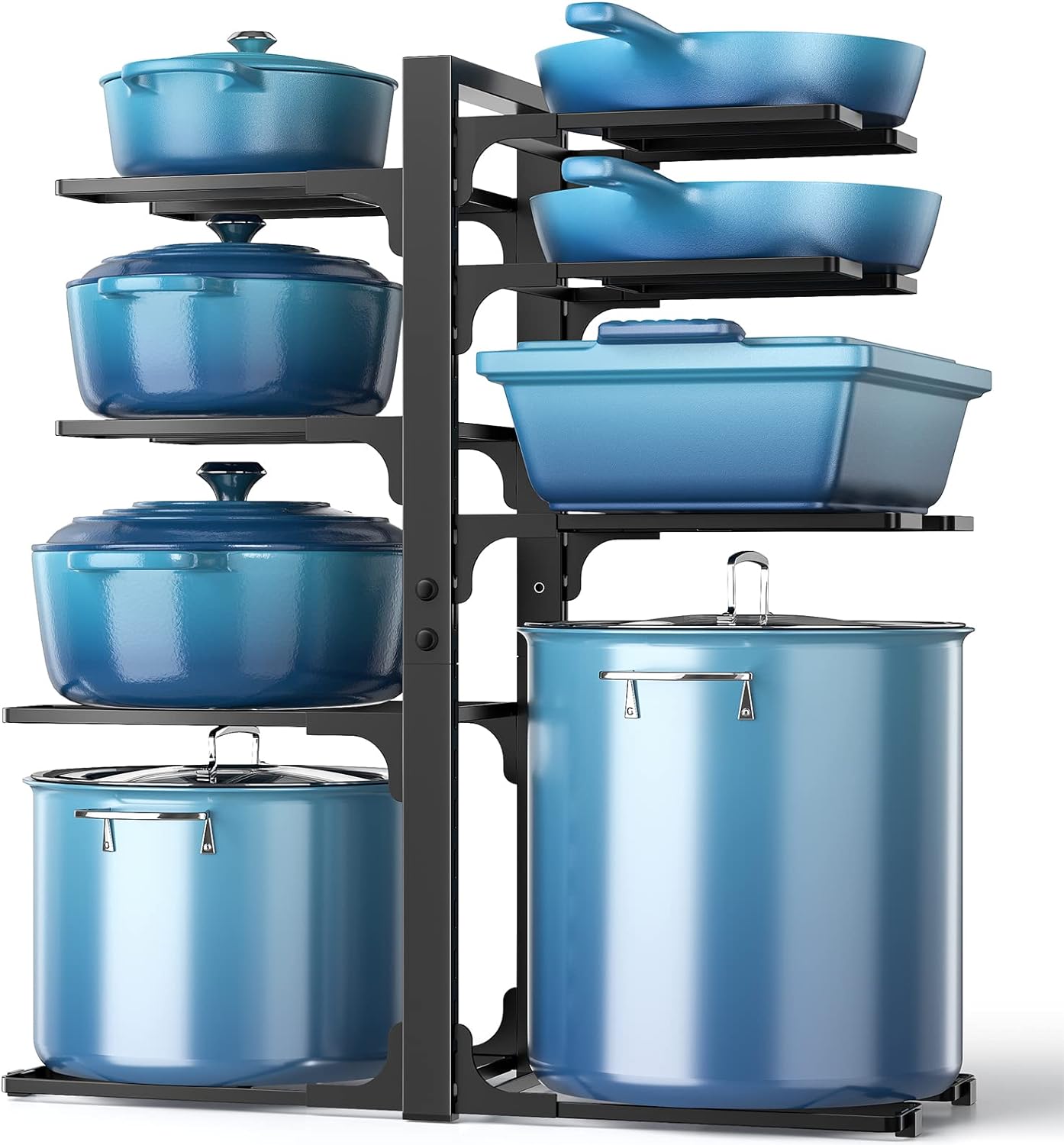
The Fix for Lids and Low Cabinets: ROOHUA Expandable Rack
This is the expandable “pot and pan lid organizer” shape that keeps showing up in 2026 organizer roundups — and it is not a shorter Ordora. It is a different tool.
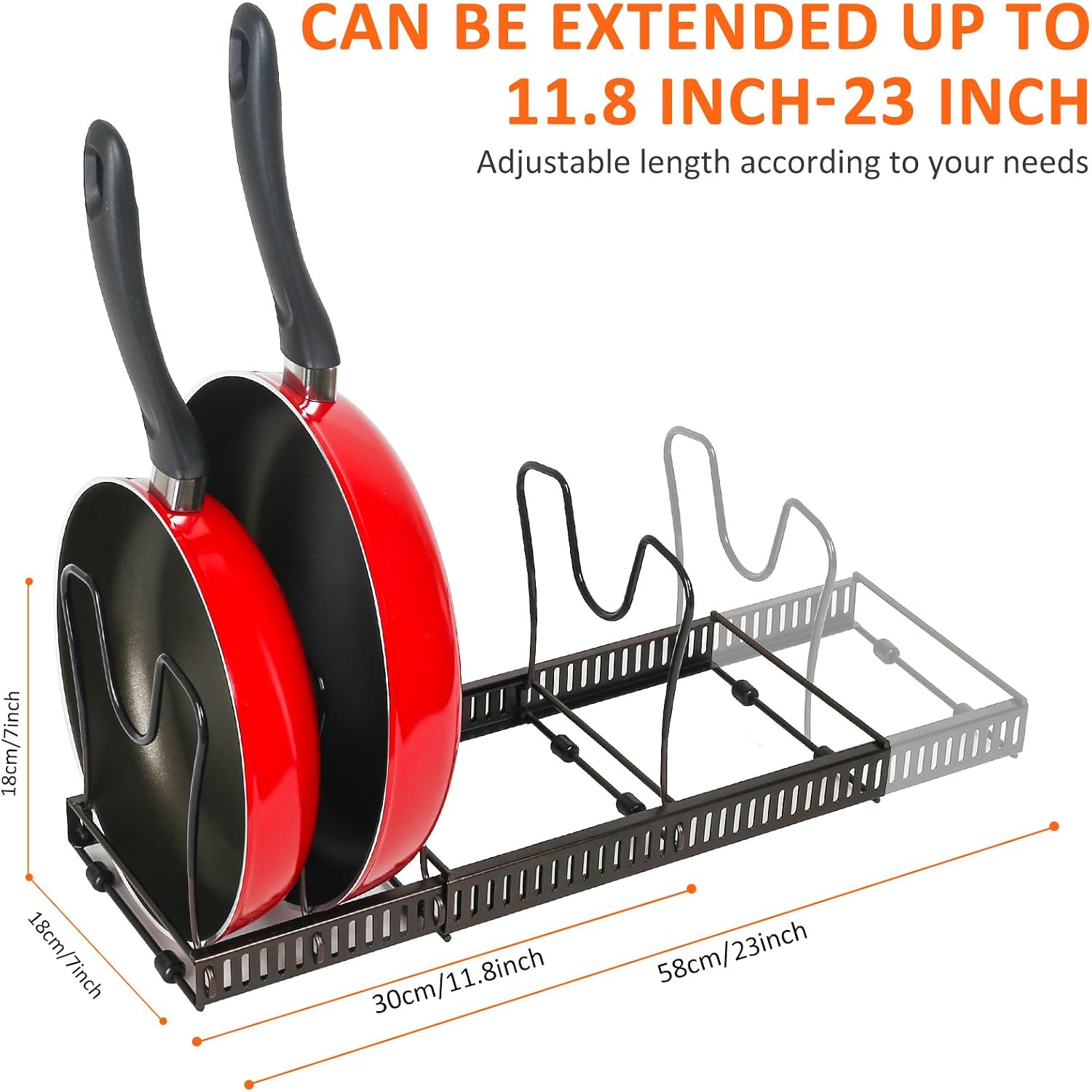
The flaw: The listing itself draws a hard line: not for heavy/deep pots and long-handled lids, and it tells you to measure cookware plus handle overhang before you buy. Product dimensions top out around 23”W × 7”D × 7”H (expanding from about 11.8” to 23” in length). That low profile is the entire point in a short opening — and the entire reason a 12-inch stockpot will look ridiculous trying to live here. U-shaped grooves favor lids with knobs; weird long handles can still flop.
Why It’s Still Worth It for the Lid Pile
After checking the live Amazon listing for ASIN B096XFTZ7L (ROOHUA, bronze option among several colors), the consensus pattern is practical: people buy this when the cabinet fight is lids, shallow pans, cookie sheets, and bakeware standing on edge in a rack that expands to the cabinet width without eating two feet of height. Listing claims include heavy iron with rubber coating, 10 adjustable dividers, U-groove lid support, tool-free assembly, a split-into-two-pieces option, and eight silicone pads for the cabinet floor. Recent listing signals at research time: about 4.4★ from roughly 5,000+ ratings, Amazon’s Choice / bestseller badges on the scrape, and ongoing sales velocity in the hundreds bought past month — useful social proof, not a lab score.
Better if: your cabinet is short, shared with a shelf, or already half-claimed by plumbing; you want lids matched and upright; you need a renter-safe rack you can pull out when you move.
Skip if: the stack that’s destroying your mornings is cast iron and tall stockpots — go back to the Ordora tower (or the Lodge counter rack below).
Choose ROOHUA instead of Ordora when height clearance is the blocker. Choose Ordora instead of ROOHUA when weight and pot height are the blocker.
- Brand / ASIN: ROOHUA · B096XFTZ7L (bronze colorway on the researched listing; other colors exist on the same family)
- Expandable length: about 11.8" to 23"; listing max install note 23 × 7 × 7 in
- Product dimensions on listing: 7"D × 23"W × 7"H class low-profile rack
- Dividers: 10 adjustable compartments; U-shaped grooves aimed at knob-style lids
- Material: iron with rubber coating (listing); includes silicone pads for the cabinet surface
- Listing fit language: aimed at roughly 6–12" cookware class items; explicitly not for heavy/deep pots and long-handled lids
- Install: pull base, insert dividers — no tools
- Consensus signal (listing check 2026-08-10): about 4.4★ from ~5,064 Amazon ratings; 300+ bought past month on the scrape snapshot
ROOHUA Expandable Pot and Pan Lid Organizer
Low 10-divider rack for lids, bakeware, and shallow pans when a tall cookware tower will not fit.
Check if the ROOHUA Pot and Pan Lid Organizer is currently in stock on Amazon →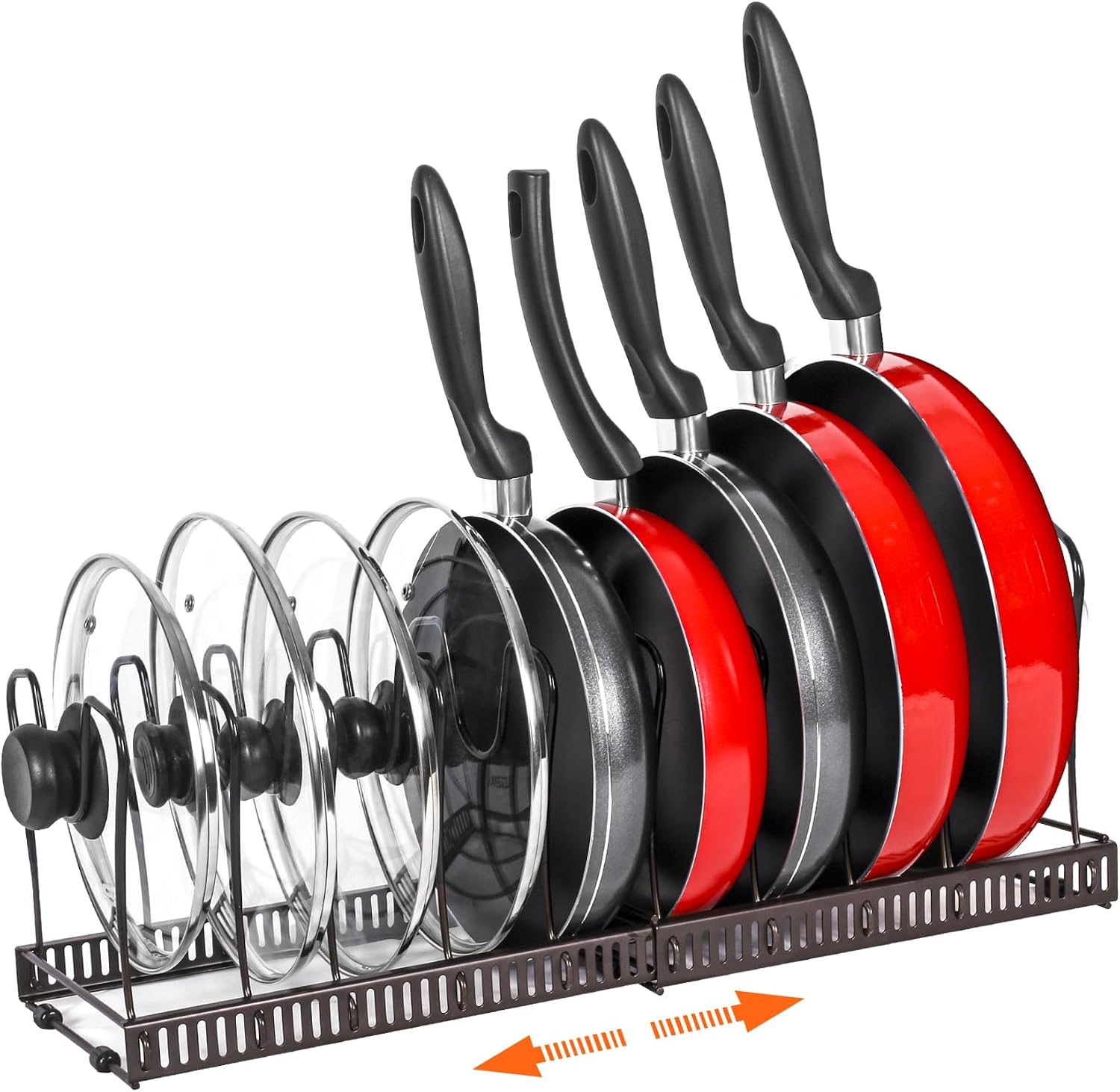
Pick by Job, Not by Thumbnail
The “Buy It For Life” Pick — Ordora tall rack
When the expensive damage is non-stick abrasion and buried stockpots, pay for height and load path. Keep the heaviest piece off a fully stretched center joint. Pair the calmer cabinet with habits that stop other kitchen piles — for example, leakproof glass food storage so leftover containers stop migrating into the cookware bay.
The Renter-Friendly Pick — ROOHUA low expandable rack
No drill, splits into two shorter runs, lives in awkward low spaces, leaves with you when the lease ends. Ideal when the viral “expandable pot pan organizer” search was really a lid-and-sheet-pan problem all along.
The Hyper-Specific Fixes
Lodge cast iron cookware organizer (countertop) — If you have counter space and hate fighting cabinets for daily cast iron, the Lodge 5-tier steel rack lives in the open: about 14.38” deep × 8.5” wide × 11.25” tall on earlier listing notes. No cabinet depth math. The tradeoff is obvious: it owns counter real estate.
See the Lodge cast iron organizer on Amazon
YouCopia StoreMore bakeware rack — Not a pot tower. It’s for flat goods: lids, cutting boards, baking sheets, muffin tins in a narrow opening. Compact footprint, adjustable wires, stays put on the shelf when the only chaos is everything flat falling like dominoes.
Check the YouCopia StoreMore on Amazon
Before you load either rack with everything you own, do one test. Put your largest everyday pan or lid into the rack the way you plan to store it. Close the cabinet door. If it closes cleanly with no contact, you're set. If a handle catches the door, push the rack farther back, flip the piece, or accept that one oversized item lives flat on the cabinet floor. Thirty seconds here beats rebuilding a full load later.
If cookware is only one of three kitchen fights this month, fix the wet zone next with a sink caddy that keeps the sponge off the deck.
One more split that saves money: storage fixes scratches; it does not un-flake a dead coating. If the skillet is already shedding nonstick into eggs, organize the cabinet and replace the pan. For the uncoated pure-titanium lane (no soft film left to peel), see when nonstick starts flaking and an uncoated titanium pan is the honest upgrade.
Start With the Worst Pan (or the Worst Lid)
Don’t reorganize the entire cookware collection in one afternoon. Pick the one piece that makes you grind your teeth — the skillet buried at the bottom of the stack, or the lid that always avalanches. Get that one piece into the correct rack first: tall tower for heavy pots, low expander for lids and flats. Once grabbing it takes one hand, the rest of the cabinet usually follows on a Saturday you already had free.
Ready to stop the scratch stack?
Choose height for heavy pots (Ordora) or a low expander for lids and bakeware (ROOHUA) — not a random rack from a thumbnail.
Check Ordora tall rack stock on Amazon →Or check the ROOHUA low expandable lid rack on Amazon →
Frequently Asked Questions
What is the best way to organize pots and pans in a cabinet?
Store cookware on edge in a rack instead of stacking it. Use a tall heavy-duty rack for stockpots and skillets when cabinet height allows, and a low expandable rack for lids, sheet pans, and shallow pieces in short openings. Measure width, height, and depth — including handle overhang — before you buy.
Should I buy a tall pan organizer or a low expandable lid rack?
Buy a tall rack like the Ordora when heavy pots and skillets need vertical slots and your base cabinet is tall enough. Buy a low expandable rack like the ROOHUA when the mess is mostly lids, bakeware, and shallow pans, or when clearance is only about 7 inches. The ROOHUA listing explicitly warns against heavy/deep pots and long-handled lids.
How do I store pot lids so they don’t fall over?
Look for U-shaped grooves on the dividers that cradle knob-style lid handles. Both the tall Ordora-style racks and the low ROOHUA expandable rack use groove geometry so lids stand upright instead of sliding into a pile. Long or odd handles may still need a different slot width or a dedicated bakeware rack.
Will a pots and pans organizer scratch my non-stick cookware?
A rack with rubberized or silicone-coated contact points is gentler than stacking pans metal-on-metal. Coated dividers still need sane loading — don’t force rough cast-iron bottoms through tight slots every day. Vertical storage removes the daily drag that scratches non-stick stacks.
What size pan organizer fits a standard base cabinet?
Standard base cabinets are often roughly 12 to 24 inches wide. Expandable racks in this guide stretch across much of that range — Ordora-style tall racks need enough height for ~20.8-inch dividers, while the ROOHUA low rack expands about 11.8 to 23 inches wide at roughly 7 inches tall. Always confirm depth so handles clear the door.
Full disclosure: As an Amazon Associate, we earn from qualifying purchases. Our recommendations are based on research, review analysis, and real household use only where explicitly noted. Commission rates play no role in what gets recommended — if a simple hardware-store fix beats a branded option, we'll say so.